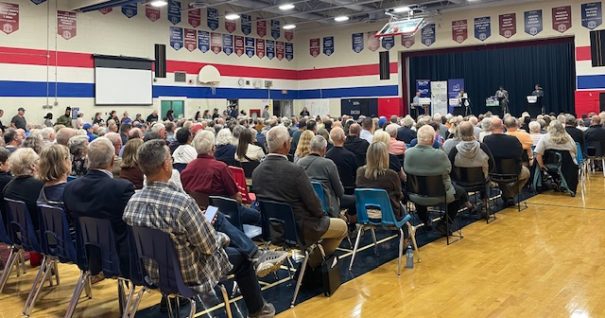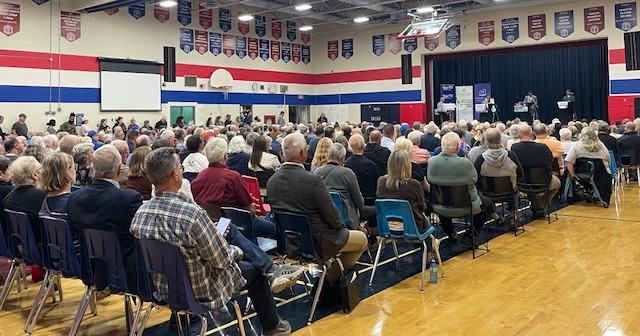
Over 300 people listened to hear the municipal election candidates at St Paul Catholic Secondary School in Trenton on October 1, 2026. Photo by Lindsey Harren.
Over 90 questions from the community were submitted to the Quinte West Chamber of Commerce, ahead of their municipal candidates event.
The All Candidates Night on Thursday at St. Paul Catholic Secondary School in Trenton had over 300 people in the gym, first listen to council candidates from Wards one to four, give a brief introduction.
The second portion of the evening had all three mayoral candidates answer questions from the moderator Jeff McKerracher, who is president of the Quinte West Chamber of Commerce.
The candidates, current Councillors Shelley Stedall and Zack Card, along with David Thomson, continued to emphasis that more community input is needed in the decision making.
The following is a summary of each mayoral candidates background, the six core questions, and some of the additional community questions that were pulled at random at the end.
Shelley Stedall highlighted that she has over 35 years of experience in government, including four-years on the current council. Stedall announced her retirement as the Chief Administrative Officer of Stirling Rawdon over the summer. She said that her experience, leadership style with mentoring staff and building teams, along with her small business background, makes her the right choice to lead a fiscally responsible council that is expected to have many new faces. Stedall shared that she has been involved with the Municipal Finance Officer Association, has the contacts, and has a deep understanding of the municipal policies. She added that at the door she is hearing that people are asking for affordability, infrastructure, responsive growth, housing choices, and better healthcare.
Zack Card advocated for a more affordable Quinte West, with accessible healthcare, voter equality across the wards, and protections for vulnerable tenants. The current councillor said he would help foster a modern and efficient City government, leaning into updating technology with one example as a ChatBot on the Quinte West website to help residents find answers fast. Card emphasized that he would foster a City Hall that focuses on community service and communication. The small business owner highlighted like Stedall, that he has hired people, and met payroll, and worked with less. Card pledged that in the first 100 days as mayor, he would ask council to put in a Renoviction Bylaw that would protect vulnerable residents and seniors from “out of town and bad faith developers.”
David Thomson openly told the crowd that he has never run in an election before, and has not served on any committees. He stated that the reason why he is running for the mayor’s seat, is because he believes he could not get done what he wants to as a councillor. He stressed that he wants a freeze on tax increases over the next term, and he would use Strong Mayor Powers to make that possible. Thomson said that every dollar spent, there should be a dollar saved. He added that if there was to be a tax rate increase proposed by council, he would veto that. He added that council would have the option to overturn his veto, and if that happened, then he would resign as mayor in that year. He said that is his “assurance to make sure that taxes stay at a zero per cent increase in the next four years.” As a self described analyzer with an agriculture background, Thomson highlighted that is is pro-development, and motions passed should be a “win for the tax payer.”
Question 1: What safeguards would you support to ensure that municipal procurement and contracting are fair, transparent, competitive, and free political influence or preferential treatment?
Stedall started off the conversation reminding the crowd that under the provincial government, municipalities are required to have standards in place for how they do procurement. She added that on top of staying within those guidelines, she wants to make sure that the City is open to local trade and shopping local. Stedall stressed the need that good staff in the office, who understand the rules and well trained, is critical. She also called that items that are coming up in the budget, need to be transparent to the public so everyone sees where the money is going. Stedall, referencing Thomson’s preference for the lowest cost, argued that in her experience the cheapest is not always the best using the example that you don’t want to repair the same road three times.
Card highlighted that an open and transparent procurement process is always the best one. Referencing the rules in place over preferential treatment, Card detailed that along with a few other councillors this termed, they learned from the Director of Finance that 98% of Quinte West’s non-software procurement is from Canadian companies.
Thomson said he does not have much experience in procurement, and ended by saying he doesn’t believe that “faireness is value.” He added that for procurement, he would be looking for the cheapest avenue.
Question Two: Identify one or two areas, where the City is spending too much or spending inefficiently? What would you change, and what would the effect be on services?
Card stressed that customer services is a great area to improve, specifically in technology. He used the idea of adding a ChatBot to the website. Card highlighted that small changes that are low cost, would create more value for tax dollars in the end. He added that decisions on reducing spending, has to be a council driven decisions as staff can not be expected to investigate without some guidance from the top.
Thomson added that while he does not know much about ChatBots, at the end of the day it is about finding people who know what they are doing. Hiring people who are competent, and “not too expensive” would be his solution.
Stedall said that while she believes there is not one area to reduce spending, she highlighted that she has worked with various departments and directors to comb through budgets and find where money can be saved. However, she highlighted that the City does provide a lot of services, and it’s not about picking on one service, but working as a team across the board.
Question Three: How should Quinte West balance new infrastructure, with the transportation, municipal services need to support growth with the existing revenues?
Thomson highlighted that there is no point expanding stressing the need to fill housing inside City limits. He pointed to a conversation he had with how the path to creating housing is siloed in different departments. Thomson wants to see conversations had with builders and construction companies, to see what can be done to speed up the process at City Hall.
Stedall said it is all about balancing new growth, and she believes that shoudl start when the application first comes to the City’s Planning Committee. She stressed that when looking at the impact of a development, it shouldn’t just be about initial things like water and sewer, but rather how that will impact the level of service for things like transportation, shops nearby, schools. One of the things she is hearing, is that the public wants to be involved more with planning.
Card added that there is always a fine balance with new builds and development charges. He noted that growth projections are key to factoring in how new builds impact current tax payers.
Question Four: What does affordable housing mean in Quinte West, and what practical steps can the municipality take to improve that affordability?
Stedall started off stating that affordable housing to her is what people can afford depending on their income, which doesn’t necessarily mean it’s rent geared to income. She said one of the big issues with affordable housing right now, isn’t just building, but rather keeping people in their homes. Stedall added that she wants to make sure there are homes for the middle class and the military. Noting that rental units and additional dwellings on homes need to be encouraged. Stedall highlighted the affordable housing project on College Street, and a new program that puts the money back in from affordable homes, into a fund to buy new sites to create more projects.
Thomson told the crowd that he believes that affordable housing is under $400,000. He wants to “get rid of the red tape and make things more efficient at City Hall” so more affordable houses can be built. He said that discussions need to be had with developers to streamline the process at City Hall and incentive builders to follow through with projects.
Card said that one of the options to make houses cheaper is to have the lowest development charges. He added that the “missing middle” in development is often townhomes and apartments that are needed for families who are starting out.
Question Five: During times when Quinte West is facing economic challenges, how should the City prioritize investments in roads, sidewalks, cycling, trails, and public transit? What tradeoffs would you make?
Card started off by saying that “at the end of the day the ratepayers are carrying the financial load on property taxes.” He added that one of the big issues in hard times is the ability for people to sustain large tax increases, noting to the impact inflation has on seniors with fixed incomes. Card added that the next four-years will be a time for real decisions, adding that there is an $11 million infrastructure gap and closing that gap to maintain the current infrastructure is Quinte West’s largest fiscal challenge. He added that the tax increase for 2026 at 4.99%, the majority of that was from the infastrucutre gap and the capital levy.
Stedall wants to focus on core services and how they can be delivered more efficiently. She said that in her 35-years, there has always been economic challenges and people do not want taxes to increase above 5 per cent. She added that it’s about talking to the public, and making sure that the priority goes to roads, water, sewer, emergency services, and environmental, while also keeping in mind the recreational needs to an aging community.
Thomson said that “roads should come at the expense of everything else.” He believes there is so much waste, when you see nice walking trails, but potholes on the roads.
Question Six: How would you expedite priority long term services, while protecting core services such as roads, infrastructure emergency services and recreations?
Thomson started off by stating he is pro-development and it is important to not get in the way. He added that things should not be dragged out or siloed at City Hall. He believes that most of the problems are internal. He said that projects can be streamlined, by talking directly with developers and builders. Thomson said that with public projects, they need to be looked at and some should not be done if the City can not afford it.
Card said that the top responsibility is to have transportation and emergency services funded first to maintain the level of service. When it comes to expediting projects, he believes there are opportunities to modernize and upgrade technology in planning and building departments. He said there should be a way to speed up private sector projects to get homes built.
Stedall agreed with Card on the need to prioritize core services. She continued that in her experience, every year you have to do something new. She pointed to the current discussions around the Arena Feasibility Study, which is looking at whether a new arena should be built. Stedall said that with core projects you have to look at what grants are available, bring the right people to the table, and look at things including public-private partnerships.
The three-candidates answered a total of six additional questions that were submitted by the community at the end, and drawn at random.
A few highlighted and summarized below.
What is one decision in the last council term you disagreed with?
Both Stedall and Card said they disagreed with the increase to water rates that went through. Thomson said he disagreed with the tax increases over the last four years. He added that over the last four years, taxes in total have gone up 25 per cent. He continued with noting that when staff brought forward the budgets, collectively they initially asked for a total tax increase of 36.9 percent over the last four years. Stedall closed the portion by adding that the decision on taxes was one by Council and staff. She believes that they can come down a little. She said the only thing she believes was missing, was getting more public input.
What is your stance on the Alto high-speed rail project?
All three candidates were against the Alto high-speed rail project in its current proposed state. They pointed to how the northern area of Quinte West would be impacted. Stedall also highlighted the need to boost access to transportation in Quinte West, particularly in the northern area. She raised the idea of possibly using CFB Trenton as a way to get flights in and out from Kingston to places like Toronto, and Ottawa. She said she would rather see the government used the Alto money to look at alternative transit measures, and put the money in affordable projects. Card said he does not support the Alto project at all, added that the southern route will slice up the municipality, raising concerns about emergency response and travel. He noted to the long term infrastructure costs. Card used the example of the cost to replace the bridge on County Road 40, adding that the rail company will pay 1/15th of the total cost to replace it. Thomson said he is against Alto, but that Quinte West needs to stand with other municipalities.
What is your stance on the proposed data centre?
Stedall stressed that at the October 7th Council meeting she will be voting to put an interim control by-law in place. The move would put a pause on current data centres that are on the table. She said that she doesn’t see enough information for what is going to happen in the next five, ten, and fifteen years. She used the example of when the windmills went in the Kingston areas years ago, as an example. She is calling for more information on what the agreements will be. Thomson noted that a lot of people have e-mailed him about the data centres, and because he is not a sitting councillor, he is not making a decision. Card stated that he agrees with the interim control by-law. He said that it is an important step in the response to the historic public feedback on the issue from the community. Card wants a long and slow process that establishes what the framework is on what agreements should look like. Card added that community conversations that are transparent, will be the way to move forward to see where the issue goes.
Advanced voting for Quinte West will take place on October 14, 17, and 20th, with Election Day on Monday, October 26th.
YourTV recorded the entire Chamber event and will air the event later on. The recorded video is expected to be posted on YourTV Quinte’s YouTube Channel, Monday.